Food industry news, market data and the science behind it. Written by a food scientist working in Indonesian food manufacturing.
Oat milk
Most oat drinks carry about 1 g of protein per 100 mL; cow's milk carries about 3.3 g • Oat protein unfolds at 113.9 °C, far higher than pea (76.5–93 °C) or soy (79–87 °C) • pH 7 → 12 → 7 alone did not help solubility • Add 100 °C for 30 minutes at pH 12, then bring it back with citric acid: about 73% stays dissolved • After 7 days, the heated sample kept more than 90% of its dissolved protein; the unheated one kept about 30% • With α-amylase plus pH-shifting at 50 °C, protein in an oat base rose from 2.0 to about 6.5 g per serving
Leave your name and email to unlock this issue. It's free, and you only do it once on this device.
Why oat milk is so low in protein, and why oat protein will not stay dissolved
What heat, pH-shifting and citric acid did in my two published studies
What happened when it went into a real oat milk bottle
Your details are used only to send Lab Notes and are never sold or shared. You can unsubscribe anytime.
01
The protein gap in oat milk
Per 100 mL · typical values
Great texture, little protein
Oat milk is made by soaking and milling oats, treating the slurry with enzymes that break starch into sugars, then filtering out the fibre. What passes through is mostly water, sugars from the oat starch, a little fat and very little protein. Many oat drinks on the shelf carry about 1 g of protein per 100 mL. Cow's milk carries about 3.3 g, and soy drinks are close to that.
Brands can close the gap by adding pea or soy protein, but that changes the label and the taste. The question my lab asked was different: can the protein that is already in oats be made to dissolve and stay dissolved, so more of it ends up in the glass?
Typical label values. Individual brands vary, especially fortified or "protein" versions.
02
Why oat protein is stubborn
~70–80%
Mostly globulin
Most oat protein is a large salt-soluble globulin (often called avenalin), built from α and β subunits of about 20–25 and 30–35 kDa. Wheat and barley lean on gluten-type proteins instead, which is part of why oats behave so differently.
113.9 °C
Very heat-stable
In my samples, oat protein isolate only unfolded at 113.9 °C. Pea protein unfolds at about 76.5–93 °C and soy at 79–87 °C. Useful for hot processing, but it also means ordinary heating barely changes it.
pH 7
Clumps at neutral pH
At the pH of a drink, oat globulin carries little net charge, so molecules stick to each other and sink. In my starting material only about 28% of the protein stayed dissolved at pH 7.
03
What I tested
Study 1 · Int. J. Biological Macromolecules (2025)
Push the pH up, heat, bring it back down
"pH-shifting" is a known trick for plant proteins: take them to a very high (or very low) pH where they unfold and repel each other, then neutralise. Earlier studies reported mixed results, and few looked closely at how hot to heat or which acid to use on the way back. So I kept everything else the same and changed just those two things.
I extracted the protein from plain rolled oats (bought at the local supermarket), defatted it and made a protein isolate with 67.6% protein. Then:
1Dissolve 1% oat protein at pH 7, raise to pH 12
2Hold at 25 °C (no heat), 50 °C or 100 °C for 30 min, then cool
3Step the pH back down to 7 with citric acid or hydrochloric acid
4Measure dissolved protein, particle size, charge and structure; store 7 days
Lowry assay for protein, Zetasizer for size and charge, DSC, SDS-PAGE, FTIR and fluorescence microscopy for structure.
04
Results
Dissolved protein back at pH 7
Heat made the difference, and citric acid beat HCl
Approximate values read from my thesis figures; each point is a mean of repeated runs.
From my bench
Spin it down and you can see it
After centrifuging, the unheated sample left a pellet of clumped protein at the bottom of the tube. The samples heated to 50 °C and 100 °C stayed milky. The pH shift on its own did almost nothing; it was the heat at pH 12 that changed the outcome.
Stability · stored at 4 °C
One week later
The test that matters for a drink is not day 0, it is the shelf. After 7 days in the fridge the unheated sample had lost most of its dissolved protein: only about 30% was left in solution. The sample heated to 100 °C kept more than 90%, with particle size holding steady at roughly 140–170 nm.
In the lab, the unheated tube built up a visible sediment layer within a day (about 1.1 cm), while the heated tubes stayed evenly cloudy all week.
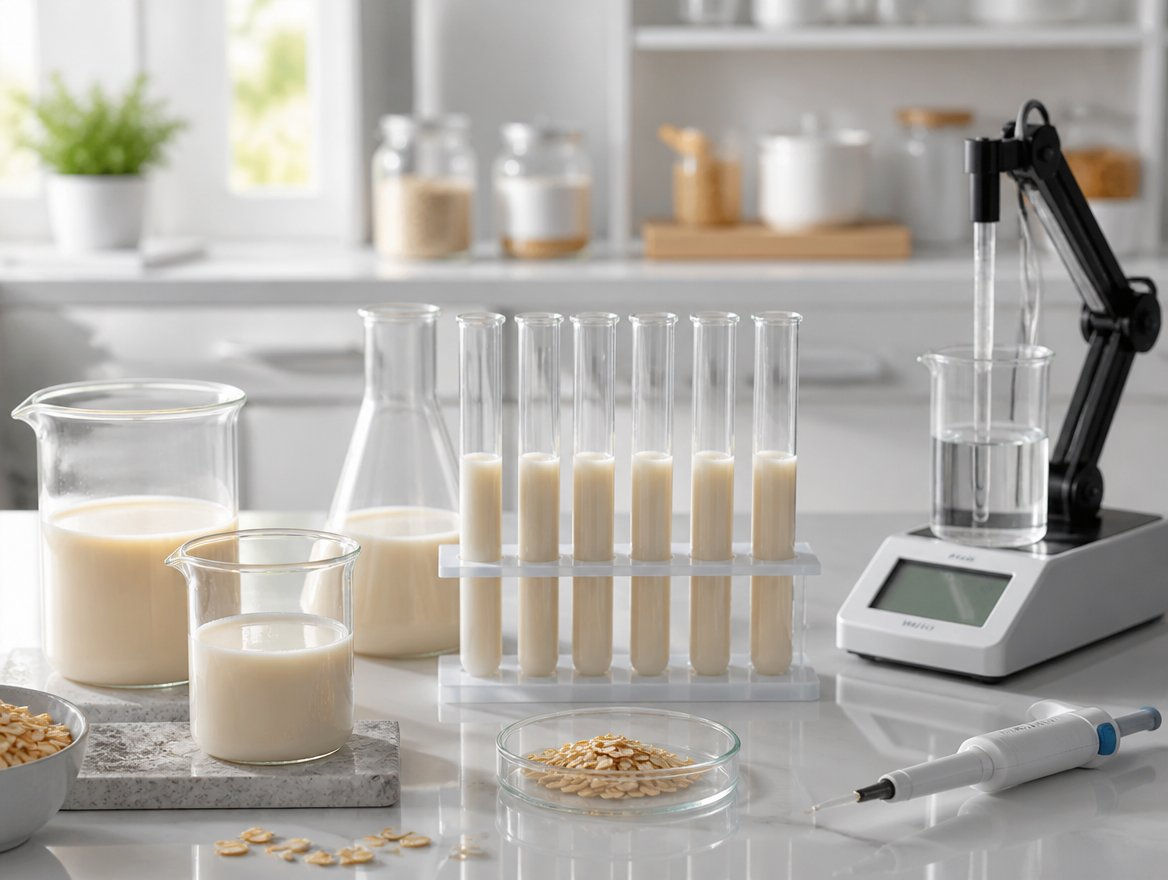
Illustration of what the stability test looked like: the unheated sample settles, heated samples stay evenly cloudy.
05
Why it works
~140–170 nm
Small particles instead of clumps
Heating the unfolded protein at pH 12 rearranged it into small, evenly sized nanoparticles. When the pH came back down, these stayed apart instead of forming the large clumps seen under the microscope in the unheated samples.
−20 mV
Charge keeps them apart
The heated particles carried a stronger negative surface charge (about −20 to −22 mV). Particles with the same charge push each other away, which stops them settling. Citric acid kept this charge higher than HCl, possibly because it binds to or coats the protein surface.
β-sheet ↓
A looser structure
DSC showed the melting peak almost disappeared after heating at pH 12, and FTIR showed fewer rigid β-sheets and more flexible β-turns and coils. A looser protein holds more water and exposes more charge.
06
From a test tube to a bottle
Study 2 · Grain & Oil Science and Technology (2026)
Same idea, applied to real oat milk bases
The second study moved from pure protein to something closer to a drink. I made oat bases from two sources, whole oat flour and oat protein isolate, and combined two steps:
α-amylase first. The enzyme breaks down starch, which otherwise makes an oat flour slurry thick and hard to handle. Lower viscosity meant the protein could disperse and the sample could be processed properly.
Then pH-shifting with mild heat: pH 7 → 12 → 7, heated at only 50 °C for 10 or 30 minutes.
Both bases improved clearly. Protein in solution rose from about 2.0 g to about 6.5 g per serving, with less sediment, smaller particles and a more negative surface charge, the same pattern as in study 1. The catch: heating at high pH made the bases darker, so colour control is the next problem to solve.
From oat flour to an oat base: milling, enzyme step and filtering. Illustration.
From my lab notebook · tasting notes
What the first prototypes tasted like
Before the paper, I made small batches just to taste them. The goal was simple: oat milk with as much protein as cow's milk.
Taste: the plain enzyme-treated oat flour milk tasted best, sweet and delicate. The pH-shifted versions came out slightly rubbery and flatter, probably from salts formed during neutralisation.
Colour: heating at high pH turned some batches brown, likely from browning reactions between sugars and protein.
Body: viscosity turned out to matter as much as solubility. At higher protein levels the drink thickens fast, which affects how well protein disperses.
So the chemistry works, but a good drink needs more than dissolved protein. That is normal for a first prototype, and it is exactly where product development starts.
The treated batches came out darker than the untreated ones. Illustration.
07
Takeaways for people who make food
Why it is interesting
Simple steps, food-friendly acid
No enzymes for the protein, no solvents, no additives beyond an alkali and citric acid, which is already a common food ingredient. Heating at 100 °C for 30 minutes is close to ordinary cooking. The same logic may help other stubborn plant proteins.
What still needs work
Scale, flavour and salt
Raising to pH 12 and neutralising leaves salt behind, which can flatten the taste. Colour has to be controlled. The next questions are scale-up in real equipment, sensory testing with consumers, and how the protein behaves with fat, sugar and minerals in a full formula.
Ref
Method & sources
Results come from my two published oat studies and my M.S. thesis. Numbers on the solubility chart are approximate readings of the thesis figures. Protein per 100 mL values are typical label figures, not measurements.
Suryamiharja A., Gong X., Wang, Mis Solval K., Zhou H. (2026). Processing effects on the characteristics of oat protein solutions: the role of enzymatic treatment and pH-shifting with mild heating. Grain & Oil Science and Technology 9:1–10.
Suryamiharja A.S. (2025). The development of health-promoting plant-based milks through a post pH-driven approach. M.S. thesis, University of Georgia. Advisor: Dr. Hualu Zhou.
Mel R. et al. (2021). Oat protein as a novel protein ingredient: structure, functionality and factors impacting. Cereal Chemistry.
McLauchlan J. et al. (2024). Oat protein review. Cited in the thesis for oat protein surface charge.
Mession J.L. et al. (2013). Thermal denaturation of pea globulins. Cited for pea and soy denaturation temperatures.
Brückner-Gühmann M. et al. (2021). Oat protein as plant-derived gelling agent. Future Foods 4:100053.
Jiang J., Chen J., Xiong Y.L. (2009). Structural and emulsifying properties of soy protein isolate subjected to acid and alkaline pH-shifting. J Agric Food Chem 57:7576.
Ercili-Cura D. et al. (2015). Adsorption of oat proteins to air–water interface. Food Hydrocolloids 44:183.
Images are illustrations and do not show the actual lab samples. Data come from the papers above.