Food industry news, market data and the science behind it. Written by a food scientist working in Indonesian food manufacturing.
Turmeric
Curcumin: C21H20O6, 368.38 g/mol • Curcuminoids make up only about 2–5% of dried turmeric • Indonesia harvested about 205,660 tonnes of turmeric in 2023, more than any other medicinal crop • East Java grows 55% of it • Yellow in acid, red in alkali: the pH colour switch explained • EFSA acceptable daily intake for curcumin (E100): 3 mg per kg body weight
Leave your name and email to unlock this issue. It's free, and you only do it once on this device.
The chemistry of curcumin and why it changes colour
What the health evidence really says, and how to absorb more
Turmeric in Indonesia, plus my own published research
Your details are used only to send Lab Notes and are never sold or shared. You can unsubscribe anytime.
01
Its chemical nature
Curcumin · C21H20O6 · 368.38 g/mol
Two phenol rings, one seven-carbon bridge
Curcumin is a diarylheptanoid: two methoxy-phenol rings joined by a seven-carbon chain. In the middle of that chain sits a 1,3-diketone that flips between a keto form and an enol form. In most solvents, and in the solid crystal, the enol form wins, because it is stabilised by an internal hydrogen bond and a long run of conjugated double bonds.
That long conjugated system is what makes curcumin yellow. It absorbs blue light at around 420–430 nm, so we see the leftover yellow-orange.
Simplified drawing. The two outer rings each carry one OH and one OCH₃ group; orange marks the double bonds of the conjugated bridge.
The pH switch
Yellow below pH 7, red-orange above pH 8
Curcumin has three acidic protons (the enol and the two phenolic OH groups), with pKa values roughly between 8 and 10.5. As the pH rises, it loses those protons, the electrons spread out further, and the colour shifts from yellow to deep red. It is the same reason turmeric turns red when it touches kapur sirih (lime paste) or baking soda.
2467891012
Approximate colour by pH (illustrative, not a calibrated scale).
From my bench
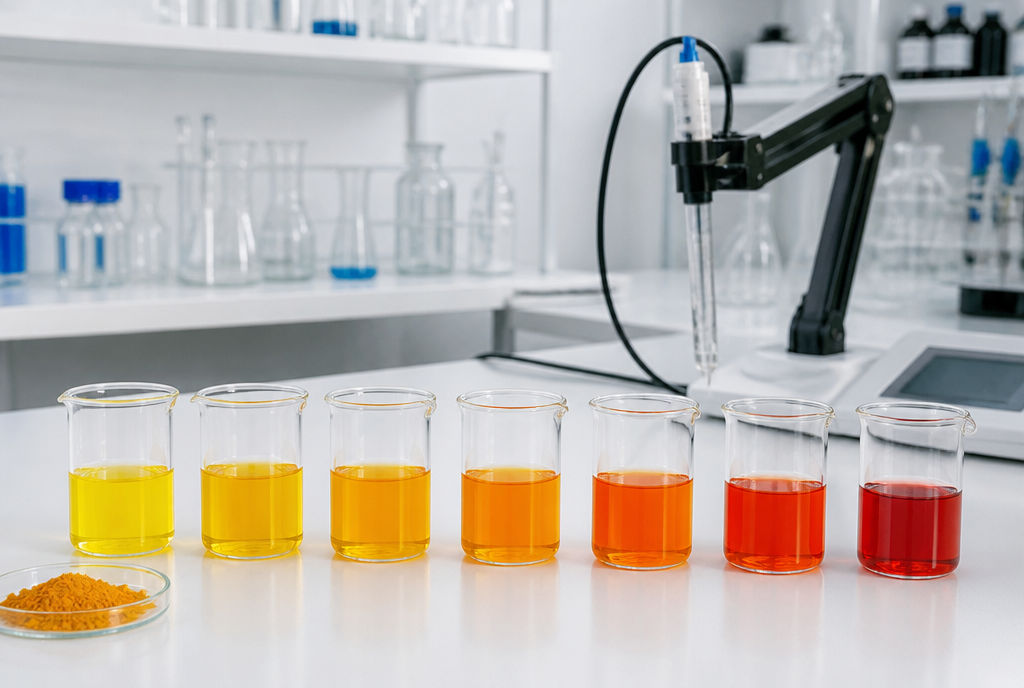
Curcumin dissolved at pH 12 turns blood red
That red beaker is curcumin in an alkaline solution during my master's work at the University of Georgia. At pH 12 it dissolves easily. Bring the pH back down and it turns yellow again and crashes out of water.
~0.01 mg/L
Barely dissolves in water
Curcumin is hydrophobic. Its water solubility at slightly acidic pH has been measured at around 11 ng per mL. It dissolves well in oil, ethanol and acetone.
pH ≥ 7
Breaks down in neutral-to-alkaline water
In a classic study at pH 7.2 and 37 °C, around 90% of curcumin degraded within 30 minutes. It is far more stable in acidic conditions and inside fat or protein.
Light
Fades under light
Curcumin is photosensitive. Yellow foods coloured with turmeric fade on a sunny shelf, which is why packaging and storage matter as much as the dose.
02
Its phenolic compounds
Curcuminoids · polyphenols
"Curcumin" on a label is usually three molecules
The yellow pigments of turmeric are called curcuminoids. They are polyphenols, and they make up only about 2–5% of the dried rhizome, depending on variety, soil and drying. Commercial "95% curcumin" extract is really a mix of three:
Curcumin, the main one, with two methoxy groups
Demethoxycurcumin (DMC), missing one methoxy group
Bisdemethoxycurcumin (BDMC), missing both
Turmeric also holds 3–7% essential oil, mainly the turmerones (ar-, α- and β-turmerone) that give its earthy smell. These are not phenolics, but they matter for flavour.
Approximate values often reported for commercial curcumin; the exact mix varies by source.
03
Health benefits: what holds up
Evidence check
Thousands of papers, fewer strong answers
Curcumin is one of the most studied food molecules in the world. In the lab it acts as an antioxidant and calms inflammation pathways. The harder question is what happens in people, at food doses.
The US National Center for Complementary and Integrative Health says there is not yet enough evidence to firmly conclude that turmeric or curcumin helps any specific health condition. Some chemists have also warned that curcumin "lights up" many lab tests without being a real drug lead, which partly explains the gap between test-tube promise and clinical results.
ClaimWhat studies showStrength
Knee osteoarthritis painSeveral meta-analyses of randomised trials report less pain and better function than placebo, and some trials find effects similar to common painkillers. Studies are small, short and vary a lot.Moderate–low
Inflammation markersPooled trials show small drops in markers such as CRP in some groups. Effect sizes vary widely between products.Low
Antioxidant activityClear in the test tube. In the body, levels of free curcumin are usually too low to explain a direct antioxidant effect.Low
Cancer, Alzheimer's, diabetesMostly cell and animal studies. Human evidence is limited and not conclusive.Very low
Safety
Food amounts are fine. Strong supplements need care.
EFSA set an acceptable daily intake for curcumin as a food colour (E100) of 3 mg per kg body weight, about 180 mg a day for a 60 kg adult. Ordinary cooking with turmeric is considered safe. Rare cases of liver injury have been linked to concentrated supplements, especially those designed to boost absorption, so anyone on medication, pregnant, or with liver or gallbladder problems should ask a doctor first.
In the kitchen
How much curcumin is in a teaspoon?
A level teaspoon of turmeric powder weighs about 3 g. At 2–5% curcuminoids, that is roughly 60–150 mg. Most clinical trials used concentrated extracts at doses of 500–1,500 mg a day, often with an absorption booster, which is very different from a glass of jamu.
04
Digestibility and absorption
Bioaccessibility vs bioavailability
Why most curcumin never reaches your blood
Bioaccessibility is the share that gets released from food and dissolved in the gut so it can be absorbed. Bioavailability is the share that actually reaches the bloodstream. Curcumin scores low on both, for four reasons:
It does not dissolve in the watery gut fluid
It breaks down at the near-neutral pH of the small intestine
The gut wall and liver quickly convert it to glucuronide and sulfate forms
What is left is cleared from the body fast
In early human trials, even 4–8 g of curcumin a day gave blood levels of only around 0.4–1.8 µM.
Simulated digestion data summarised in our review on plant-based milks (Sustainable Food Proteins, 2024).
Fat
Cook it in oil or drink it with milk
Fat droplets give curcumin a place to dissolve and get packed into the mixed micelles the gut uses to absorb fats. Gulai, curry and golden milk all do this by accident.
Black pepper
Piperine slows the clean-up
Piperine from black pepper blocks some of the enzymes that convert curcumin. One small 1998 human study reported a jump of about 2,000% in blood levels. Later studies are less consistent, so treat that number as an upper bound.
Protein & encapsulation
Carriers protect it on the way
Proteins (soy, whey, pea), emulsions and other carriers bind curcumin, shield it from breakdown and keep it dispersed in water-based foods and drinks.
05
Applications
From jamu to E100
A colour, a spice and a functional ingredient
Indonesian cooking: nasi kuning, opor, gulai, soto, acar kuning, ayam goreng bumbu kuning and yellow tofu all lean on turmeric for colour and aroma.
Traditional drinks: jamu kunyit asam pairs turmeric with tamarind. The acidity also helps keep curcumin stable and yellow.
Natural colour E100: curcumin and turmeric oleoresin colour mustard, dairy desserts, ice cream, snacks, noodles, margarine and drinks.
Functional drinks: golden milk and turmeric lattes, increasingly in plant-based versions.
Supplements: capsules with concentrated curcuminoids, often with piperine or special carriers.
Food science note: designing with turmeric
For colour, keep the product slightly acidic, protect it from light, and avoid alkaline ingredients such as baking soda or lime water, which turn it red-brown. For a "functional" claim, the bigger challenge is getting curcumin dissolved and absorbed, which is where fat, protein and encapsulation come in. Any health claim on a label must follow the food regulator's rules.
06
Source in Indonesia
BPS · 2023
About 205,660 tonnes, and Indonesia's top medicinal crop
Indonesia harvested about 205,660 tonnes of turmeric in 2023, up 4.7% from 2022 and the highest in five years. Kunyit is the most produced crop in the country's medicinal-plant (biofarmaka) statistics, ahead of ginger and galangal.
East Java alone grew about 113,280 tonnes, or 55% of the national total, followed by West Java and Central Java. Indonesia also exports turmeric, competing with India, the world's largest producer.
Source: BPS, compiled by Databoks and RRI. Total 205.66 thousand tonnes; "other" is the remainder.
From field to powder
Harvested at 8–10 months, boiled, dried and ground
Turmeric is a rhizome of Curcuma longa, a ginger-family plant that grows well in Indonesia's lowlands and under tree cover. Rhizomes are usually harvested 8–10 months after planting, when the leaves turn yellow. They are boiled or steamed, sun- or oven-dried, then ground. Each step affects the final curcuminoid content and colour, so the same "turmeric powder" can vary widely between batches.
Photo: illustration
07
My research on it
University of Georgia · Food Frontiers, 2024
Putting real turmeric, not pure curcumin, into soymilk in one step
Most studies that add curcumin to drinks use purified curcumin, which takes solvents and energy to make. In my master's research with Dr. Hualu Zhou, we asked a simpler question: can we skip the purified powder and pull curcumin straight from turmeric, right into the milk?
We used a "two-in-one post pH-driven" method. Turmeric powder goes into a small amount of alkaline solution, where curcumin loses its protons and dissolves (the red beaker above). That solution is added to soymilk, then the pH is brought back to neutral with citric acid. Curcumin turns back to its neutral form, becomes water-hating again, and moves into the soymilk's oil droplets, where it is protected.
1Turmeric powder in a little 0.1 M KOH, mixed for 1 minute
2Spin down the solids, keep the red liquid
3Add to soymilk
4Neutralise with citric acid: curcumin moves into the oil droplets
96.4%
Extraction efficiency
Share of curcumin pulled out of the turmeric powder (± 0.5%).
94.2%
Two-in-one efficiency
Share that ended up encapsulated in the soymilk in one step (± 1.6%).
22×
Lower carbon footprint
Using raw turmeric instead of purified curcumin cut the raw-material CO₂-equivalent 22-fold and embodied energy 10-fold.
What else we saw
Yellow colour, same milk, stable when frozen
Even at only about 0.03% curcumin, the soymilk turned a clear yellow. Particle size, surface charge and melting behaviour did not change, because the curcumin sat inside the existing oil droplets. Freeze-dried powder kept its curcumin for a month in the freezer.
The lesson I took into industry is simple: using raw ingredients and fewer processing steps can make a product both cheaper to make and lighter on the environment, without losing function. A sister study turned the idea into an instant golden milk powder.
Suryamiharja A., Gong X., Zhou H. (2024). Curcumin-infused plant-based milk with a two-in-one post pH-driven strategy. Food Frontiers. doi:10.1002/fft2.534